

The emergence of the “Popealogy” movement marked a pivotal moment in the genealogy and religious communities after the historic election of Pope Leo XIV. As the first American-born pope, his ascension to the papal office ignited widespread interest amongst not only Catholics but also researchers, historians, and everyday genealogy enthusiasts. They captivated by the opportunity to trace the lineage of a modern religious leader that embodied the complexity and diversity of the American experience.
Pope Leo XIV’s ancestry revealed a richly woven tapestry of Creole, African-American, French, and Caribbean roots, challenging the long-standing perceptions about identity, race, and representation at the highest levels of the Catholic Church, with a historical migration from New Orleans to Chicago. With this new found interest, genealogists quickly flocked to fill in the missing pieces and culminated in the reaffirmation of America’s melting pot.
How It Began
Jari Honora, a historian for the Historic New Orleans Collection, uncovered details about the Pope’s maternal great-grandparents. Through meticulous archival research and analysis of historical records, Honora uncovered that all four of the pope’s maternal great-grandparents were listed as free people of color living in New Orleans’s historic Seventh Ward during the 19th century. This neighborhood, known for its vibrant Creole community and complex cultural heritage, was home to many mixed-race families of French, Spanish, African, and Caribbean descent who had carved out a distinct identity in a racially stratified society.
Honora’s research traced the Pope’s lineage through census data, marriage records, and church documents, revealing a compelling narrative of a family that, over time, migrated from the racially diverse South to the urban North, eventually altering how they were recorded racially in public records. This discovery illuminated a broader historical pattern of racial passing during the Jim Crow era and highlighted the enduring legacy of Creole culture in shaping American identity.
What made this work truly groundbreaking was that Honora was the first to bring these findings to public attention, publishing and sharing them with major institutions and media outlets on May 9, 2025, not even twenty-four hours after Pope Leo XIV’s election. The solving of this mytery intrigued the genealogists within The Genealogy Discord community, who were following the Popealogy movement with great interest.
Yet one significant mystery continued to loom large in the ancestral narrative of Pope Leo XIV: the origins of his paternal-line ancestors, John (or Jean) R. Prevost and Suzanne Fabre (alternatively recorded as Suzanne Fontaine). Historical records referencing the couple were inconsistent. Not only in the spelling of their names but also in their stated countries of origin. Some documents suggested France, others hinted at Italy, and none provided definitive clarity. This ambiguity sparked ongoing intrigue and a renewed effort among genealogists and historians to trace their precise roots and determine where in France or Italy this elusive couple had come from.
Research Timeline
The Breadcrumbs
Research into John R. Prevost began as it often does in genealogical investigations, examining readily available records and gradually delving into more obscure archives in search of elusive clues. The information initially available on John R. Prevost was limited: a Chicago baptismal record for Louis Prevost, the father of Pope Leo XIV; a few U.S. census entries; and a death record from 1960 in Cook County, listing a birthday of June 24, 1876, and a birth origin in Italy. Beyond these, details about John and his wife, Suzanne, were scarce.
To expand the search, all known instances of John Prevost were analyzed using genealogical databases such as Ancestry.com, FamilySearch.org, and Newspapers.com, but these yielded no definitive leads about his early life or geographic origins. With little to go on, the search parameters were broadened to include any mention of the surname “Prevost” in Chicago-area newspapers. This wider net finally produced a potential lead: a 1934 advertisement in the Chicago Tribune referencing the Riggitano-Prevost School. Though a small mention, this reference offered a valuable new thread to follow in the ongoing effort to trace the origins of the Prevost family.
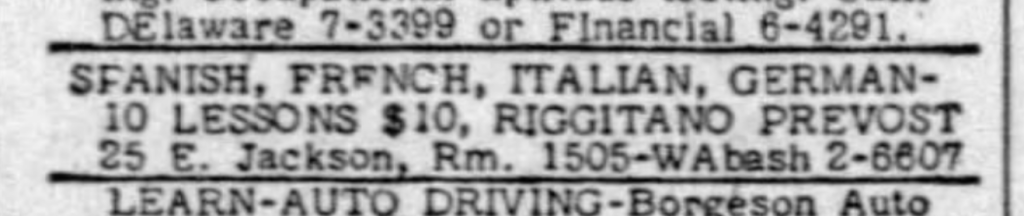
The address in the advertisement led researchers to 25 E. Jackson Street, now part of DePaul University and coincidentally, the institution from which Louis Prevost, Pope Leo XIV’s father, would graduate years after the ad was printed. The overlap, while circumstantial, was too striking for researchers to ignore.
To pursue the lead further, they applied the FAN principle, a genealogical research method developed by Elizabeth Shown Mills that focuses on investigating an individual’s Friends, Associates, and Neighbors. Using this approach, attention turned to the name Riggitano in an effort to uncover possible connections between the Riggitano and Prevost families. Specifically, our research focused on how a close relationship or shared community ties might explain their collaboration in operating a business together.
Narrowing down our search to “Riggitano” in Chicago, very few results appeared. There was one glaring result: Salvatore Giovanni Riggitano’s WWI Draft Registration Card, in which the only details we know of John R Prevost were present: a birthdate of 24 June 1876 and a birthplace of Italy.
Plenty of people share a birth date, so how do we prove it? Our researchers began to extensively delve into Salvatore Giovanni Riggitano’s life and piece together all of the clues and find what else could line up.

The Genealogy Discord community meticulously compiled the evidence into a comprehensive research document, constructing a detailed timeline, applying advanced FAN methodology, and critically analyzing all available records. Their objective was clear: to investigate the growing theory that John R. Prevost and Salvatore Giovanni Riggitano were, in fact, the same individual. As the pieces of the puzzle came together, one key source emerged that would confirm their suspicions.
The breakthrough came in the form of a 1917 article from the Quincy Daily Gate, which revealed that Salvatore Riggitano had been accused of adultery by his wife, Daisy, naming the other woman as a young language teacher: Suzanne Fontaine. This revelation aligned perfectly with prior research into John R. Prevost’s partner, whose name had also appeared as Suzanne Fabre or Suzanne Fontaine in various records.
This article provided the conclusive link the researchers needed. The longstanding hunch had been correct. Giovanni Riggitano, as he styled himself in certain advertisements, was in fact John R. Prevost. The alias, the personal connections, and the overlapping timelines all confirmed that the two identities belonged to the same man, marking a major milestone in the genealogical investigation.
Our Publishing Process
To help bring our research to a wider audience, several members of our research team also happened to be colleagues at Geneanet, the French division of Ancestry.com, and leveraged their access to additional European and immigration records. Geneanet contributed critical new evidence, including an Alien Registration Form and documentation showing that a child named John Prevost, born in 1917 to Jean R Prevost and Suzanne Fontaine, had been placed in an Infants’ Home for Unwed Mothers in Lackawanna, New York. This discovery not only corroborated the timeline and identity links we had been building, but also provided further context for the complex personal history of Salvatore Giovanni Riggitano, a.k.a. John R. Prevost.
Armed with this expanded body of evidence, and in collaboration with Sean Daly of Geneanet, the team was able to publish the first version of the story. The story of Salvatore Riggitano’s double life thus reached its first major audience. Behind the scenes, however, the team continued refining the research, working diligently to compile a formal genealogical proof argument. This document aimed to present all findings in a clear, sourced, and methodical format, suitable for both scholarly review and public reference. As anticipation built, the team was preparing for the next crucial step: publishing the full proof case that would establish, beyond doubt, the true identity and legacy of John R. Prevost. On May 13th, 2025, we published “One Man, Two Identities: How Salvatore Giovanni Riggitano lived his life as John R. Prevost.”
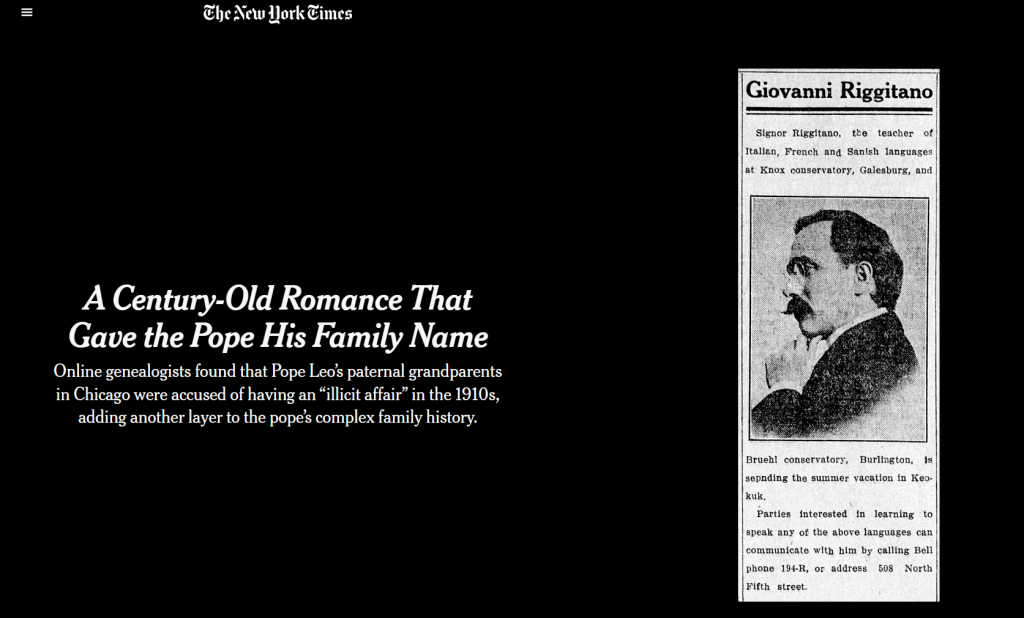
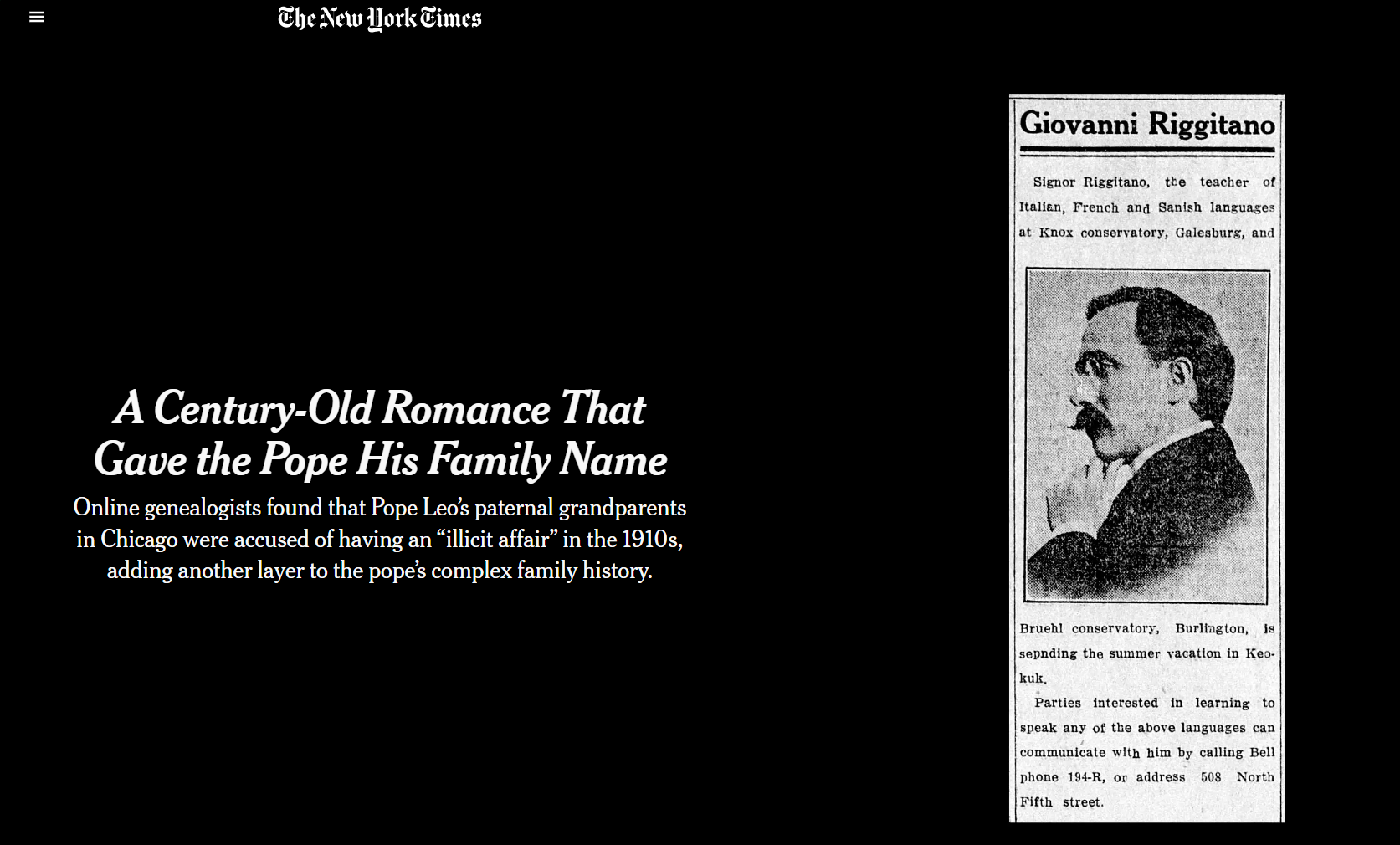
To take everything to new heights, on May 15th, 2025, the New York Times published “A Century-Old Romance That Gave the Pope His Family Name”, citing and referencing The Genealogy Discord for our research on Salvatore Giovanni Riggitano and Suzanne Fontaine.
Voices Heard
A long-standing community member and respected genealogy influencer, Jarrett Ross, known widely as The GeneaVlogger, reached out to our research team after reviewing the emerging findings on Giovanni Riggitano. Recognizing the historical and genealogical significance of the case, he extended an invitation for our team’s lead administrator to appear on an upcoming livecast to discuss the research in depth. As a professional genealogist with expertise in Jewish genealogy and a reputation for conducting high-quality investigative work, Jarrett’s platform offered an ideal opportunity to present the story to a broader, engaged audience.
The livecast, part of The GeneaVlogger’s ongoing series that highlights culturally relevant and methodologically rigorous genealogical research, provided a collaborative and insightful space to unpack the complexities of the Riggitano/Prevost case. Also joining the panel was Kyle Betit, founder of AncestryProGenealogists®, whose expertise in immigration records and international family history added further depth to the discussion. Together, the panel explored not only the genealogical techniques behind the discovery but also the broader implications for understanding identity, migration, and historical memory in American and European contexts.
Have your own brickwall?
Ready to discover your own family story or break through a tough genealogical brick wall, while making lifelong friends along the way? Join the Genealogy Discord server, where researchers of all levels come together to share tools, solve mysteries, and support each other on the journey through history. Your ancestors’ stories are waiting. Start uncovering them today!
Leave a Reply